
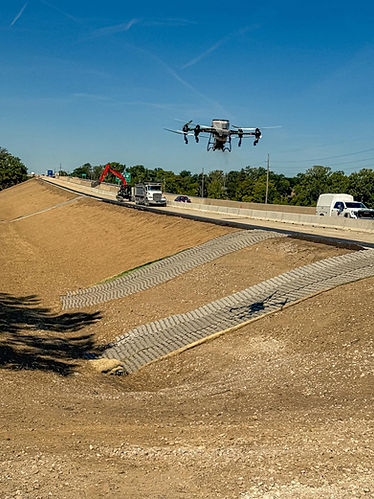
Area Treated: Reservoir embankment and a reconstructed wetland area. Newly placed soils needed stabilization, and vegetation establishment was required.
Project Objective: The objective of drone based seeding was to seed and fertilize the area to encourage rapid vegetative growth and facilitate the successful establishment of a functional wetland ecosystem.
Why an aerial solution? Recently reconstructed soils were too soft to safely support heavy equipment or foot traffic. Drone-based seeding and fertilizer application provided uniform coverage without disturbing the soil, compacting it, or posing safety risks.
Method & Precision: Aerial application ensured consistent seed distribution and precise fertilizer placement, safeguarding the newly constructed wetland’s integrity.
Long-term Management Value: Early vegetation establishment stabilizes soils, improves water quality, and accelerates the development of wetland habitat within the reservoir system, drone based seeding.

Key Aspects
Drone Based Seeding & Fertilizer
-
Technological Capabilities: Modern agricultural drones, such as the DJI Agras series, can carry up to 30 kg (approx. 66 lbs) of payload. They use GNSS guidance for, precise, autonomous flight, ensuring uniform application.
-
Fertilizer Application: Drones excel at applying liquid or granular fertilizers. They are particularly useful for targeted nutrient delivery, such as applying chelated iron to iron-deficient trees in sandy soils. They can also deliver specialized micronutrients (zinc, boron, manganese).
-
Seed Spreading: Drones are used for seeding cover crops (e.g., rye, radish, turnip) and, in some regions, for sowing rice. They are effective for interseeding, which allows for establishing cover crops while standing cash crops are still in the field.
-
Benefits of Drone Based Seeding over Traditional Methods:
-
Access: Drones operate in rugged, hilly, or flooded areas that tractors cannot access.
-
Reduced Soil Compaction: Eliminates the need for heavy machinery passing over the field.
-
Efficiency: They offer 15-25% higher nutrient efficiency compared to uniform application, reducing costs and environmental leaching.
-
Speed: They can operate 40x faster than manual spreading.
-
-
Operational Considerations: Drone based seeding and fertilizer require planning, including managing battery life (approx. 40-minute flight times) and navigating legal regulations, which vary by country.